
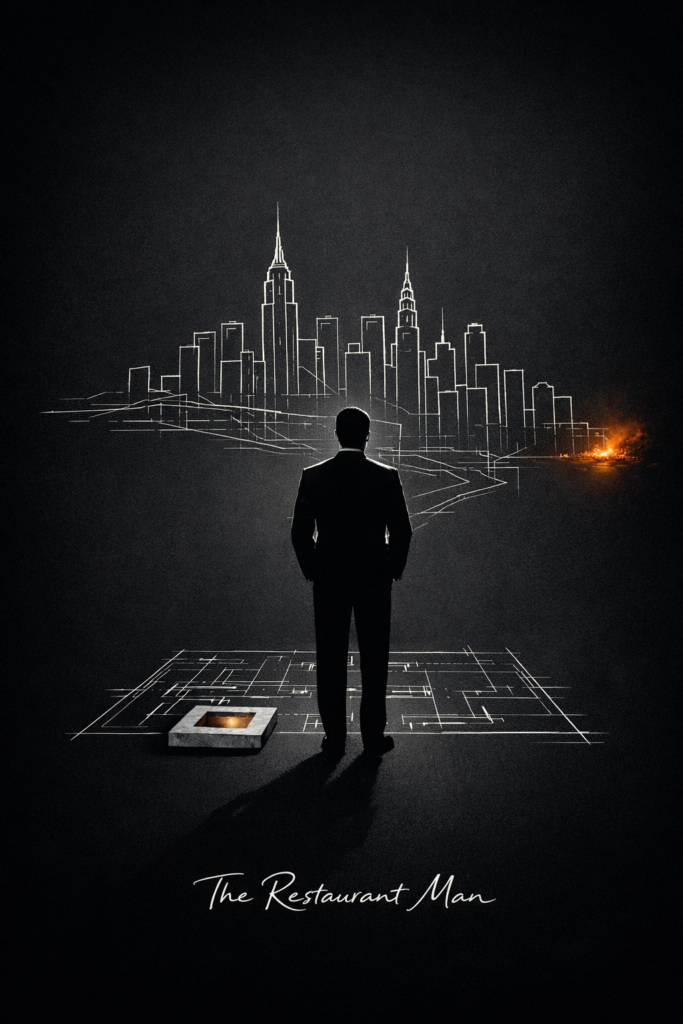
“The Restaurant Man” chronicles the life of Joe Baum, the visionary restaurateur who revolutionized New York City dining from the 1950s through the 1990s. While the writer’s passion and thorough research are evident throughout this 113-page screenplay, the script struggles to transform historical documentation into compelling drama.
The biographical structure follows Baum’s career chronologically, from a 1934 childhood memory in the Catskill Mountains through his major achievements—The Newarker, The Four Seasons, La Fonda del Sol, Windows on the World—culminating in his death in 1998. Unfortunately, this approach reads more like an illustrated Wikipedia entry than a character-driven narrative. The script dutifully hits career milestones but lacks the emotional throughline necessary for engaging cinema.
Joe Baum emerges as perpetually visionary and confident, with little complexity or contradiction. We see his successes but rarely his failures, his vision but seldom his doubts. The childhood scenes feel perfunctory and disconnected from the man he becomes. Supporting characters—Jerry Brody, Ruth Baum, James Beard, various critics—function primarily as validators of Baum’s genius rather than fully realized individuals with their own arcs. Ruth’s final monologue cataloging her husband’s accomplishments is emotionally resonant but exemplifies the script’s fatal flaw: telling rather than showing.
The dialogue relies heavily on exposition, with characters articulating themes and significance rather than allowing organic discovery. Discussions about restaurant concepts read like business proposals instead of passionate creative exchanges. When Joe explains his “tabula rasa” philosophy about silverware placement, it feels like a lecture, not a conversation.
Despite meticulous period detail and extensive research into each restaurant’s innovations, the dramatic stakes feel curiously low. We’re told about challenges but rarely feel genuine tension. Conflict is external and easily overcome rather than internal and transformative. The episodic structure, marked by repetitive “FADE TO BLACK” transitions and postcard dissolves, undermines narrative momentum. Scenes feel isolated, connected by chronology rather than dramatic cause and effect.
Most problematic is the script’s avoidance of darkness and conflict. Beyond brief mentions of financial challenges and perfectionism, we see little personal cost to Baum’s ambition. What impact did his work have on family relationships? What dreams went unrealized? What mistakes haunted him? The final scene hints at inadequacy, but it arrives too late and feels unearned given the preceding triumphant tone.
The pacing suffers from treating all scenes as roughly equal in weight. The childhood sequence receives comparable screen time to The Four Seasons opening, despite vastly different significance. The extensive end cards comparing actors to real people suggest documentary impulses at odds with dramatic storytelling, revealing uncertainty about whether this is interpretation or historical record.
What works: the appreciation for dining’s sensory world, the understanding of design and service innovations, and the core idea that someone could revolutionize an industry through imagination and persistence. The raw material is here—a fascinating figure, transformative era, vibrant setting, and significant cultural impact.
What’s needed: This script requires substantial revision. The story needs tighter focus, perhaps concentrating on one or two pivotal restaurants rather than covering an entire career. Joe Baum needs contradictions, flaws, and failures. Supporting characters need their own conflicts. Dialogue must sound like human conversation, not history lessons. Most critically, the script must identify its deeper theme—is it about the price of perfection? Art versus commerce? The meaning of legacy?
“The Restaurant Man” feels like a first draft from a writer who has researched admirably but hasn’t yet found the story within the history. The courage is missing to move beyond reverence into genuine dramatic exploration, to find the darkness that makes light meaningful. A complicated, struggling, sometimes-failing human being would honor Joe Baum’s legacy more than an unblemished visionary. With revision focused on character depth, dramatic structure, and thematic coherence, this could become a meaningful tribute. As it stands, it’s a respectful outline waiting to become a story—less Wikipedia and more heart, less biography and more drama, less telling and more showing
Writer Biography

Don Boudreau is a NJ native, the author of four books, including Joseph Baum & The Newarker Restaurant, which inspired the writing of his screenplay, THE RESTAURANT MAN, on the life and career of legendary New York City restaurateur, Joe Baum.