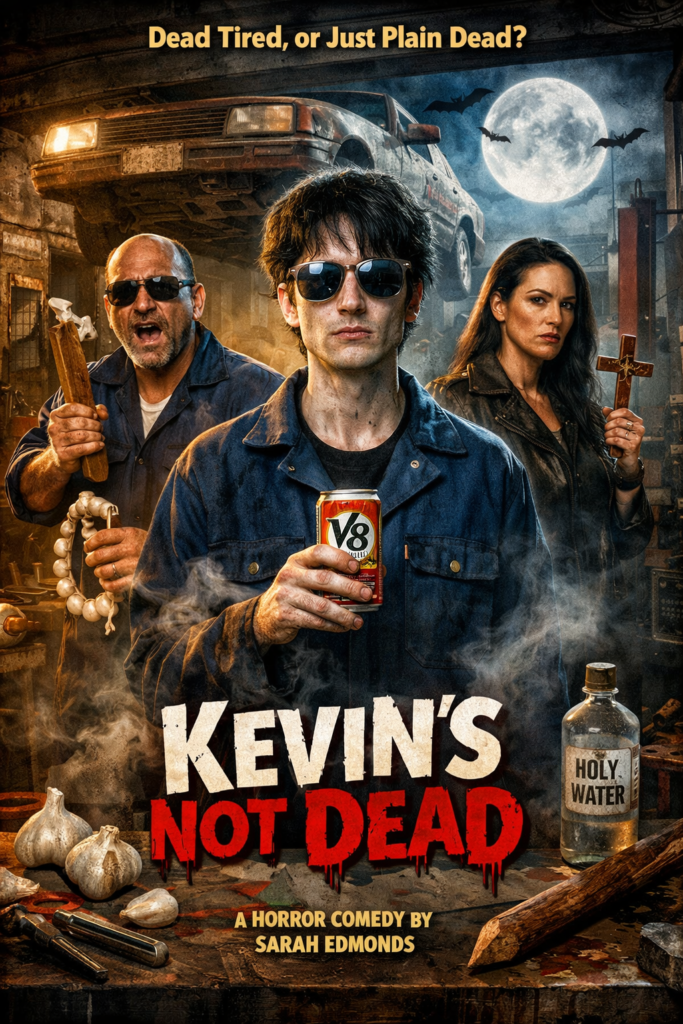
There’s something wonderfully suspicious about the ordinary in Sarah Edmonds’ script Kevin’s Not Dead. At first glance, the story unfolds inside a greasy, half-broken automotive garage—Sean’s Automotive Center—where clanking tools, bad coffee, and workplace sarcasm form the rhythm of daily life. But beneath the grease-stained floors and dysfunctional camaraderie lurks a question that slowly begins to echo through the narrative: what if the weird guy at work isn’t just weird?
Edmonds crafts a world where the mundane and the supernatural collide with comedic precision. The mechanics—G-Man, Greg, and Kevin—aren’t heroic figures or gothic archetypes. They are exhausted workers arguing over tools, coffee, and broken cars. Yet when the mysterious Felicia “Stone” arrives, carrying the weight of a centuries-old vampire-hunting legacy, the garage suddenly becomes the stage for something far stranger than routine repair work.
The brilliance of the script lies in how it refuses to rush the absurdity. Instead, the suspicion builds through small, hilarious observations: Kevin drinks suspicious amounts of V8, avoids sunlight with militant dedication, and somehow survives accidents that should logically be fatal. The characters’ attempts to test these theories—garlic, holy water, sunlight—turn the workplace into a chaotic laboratory of amateur vampire detection.
But Kevin’s Not Dead is not simply parody. Beneath its sharp humor lies a story about fear, misunderstanding, and loyalty. The script asks a subtle question: if someone is different—possibly even monstrous—does that automatically make them dangerous? Kevin’s quiet kindness constantly contradicts the growing paranoia around him, creating a comedic tension that drives the story forward.
Character dynamics are where the script truly shines. G-Man’s reckless enthusiasm fuels the chaos, Greg’s skepticism grounds the narrative, and Stone’s intense seriousness adds a dramatic edge that clashes hilariously with the mechanics’ blue-collar cynicism. Kevin himself remains an enigma—both the center of the mystery and the calm eye within the storm.
Tonally, the screenplay dances between genres with surprising confidence. It carries the playful irreverence of modern horror comedies while maintaining the intimacy of a workplace ensemble story. The repair shop becomes more than a setting—it’s a battlefield of misunderstandings, where car lifts, toolboxes, and coffee breaks coexist with vampire lore and improvised supernatural traps.
What makes Kevin’s Not Dead memorable is its ability to transform the everyday into something mythic without losing its sense of humor. The script reminds us that sometimes the scariest thing isn’t a vampire—it’s the possibility that we’ve been judging the wrong monster all along.
In the end, Edmonds delivers a story that is strange, funny, and unexpectedly warm—a horror comedy where the greatest mystery isn’t whether Kevin is undead, but whether the world around him is ready to accept him if he is.