
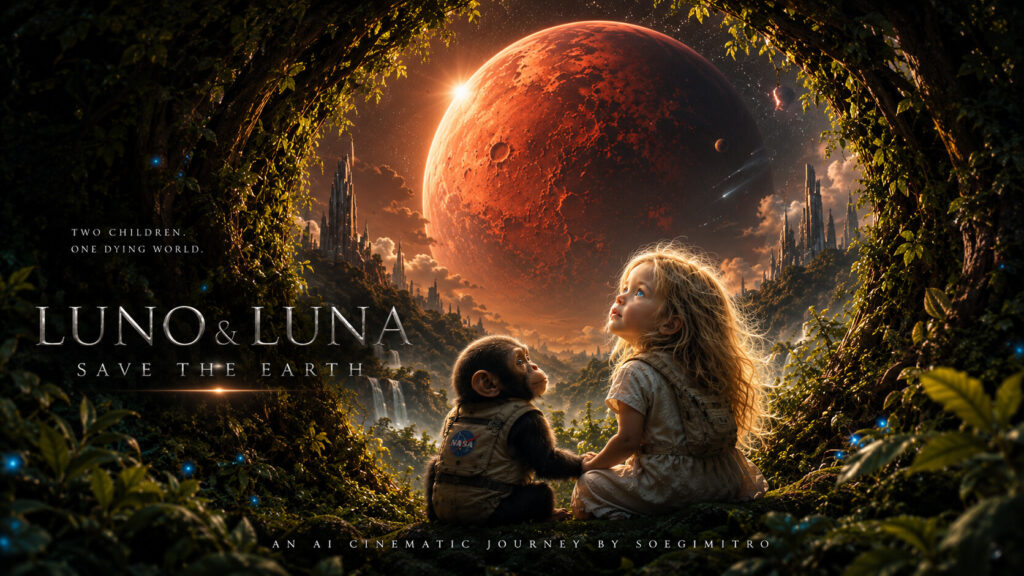
Directed by Soegimitro Boom
Ratings: 7/10
There is something quietly audacious about Luno & Luna: Save The Earth. In a moment when AI-generated imagery still provokes suspicion in cinematic circles, director Soegimitro Boom arrives not with an apology but with a manifesto — a film that places generative AI at the very centre of its storytelling apparatus and dares the audience to feel something real within it.
The gamble, to a remarkable degree, pays off.
A World Built From Algorithms and Wonder
The film opens on African wilderness rendered with a painter’s extravagance — cascading waterfalls, dense flora, a sense of primordial abundance that feels both photographic and impossible at once. This is the visual register Boom sustains throughout: familiar enough to ground us emotionally, strange enough to remind us that we are watching something genuinely new. The production value is, by any measure, extraordinary. The generative AI has not been deployed as a shortcut here; it has been wielded as a creative instrument, producing imagery that shifts registers fluently — from the organic lushness of Africa to the cold geometries of outer space — without ever losing visual coherence.
The story at the film’s heart is an old and resonant one: a hyper-intelligent chimpanzee, Luno, is torn from his natural world and deposited into a New York circus, where his remarkable intellect is exploited as spectacle. Running in parallel is Luna, a young human girl whose environmental activism gradually intertwines with Luno’s fate. The premise is rich with thematic possibility — the ethics of intelligence, the violence of captivity, the idea that empathy across species might be the one resource Earth actually needs.
The Wound That Opens the Film
Before Luno becomes a symbol, before he becomes a spectacle, before he becomes a hope — he is simply taken.
The film’s opening does not shy away from the foundational violence of that act: wild animals seized from their natural world, their families, their entire sensory universe, and funnelled into a trade that has nothing to do with them and everything to do with human greed. What makes this sequence so quietly devastating is what it does not show — the reunion that never happens, the family unit that waits in the wilderness for a member who will not return. Luno does not get a second chance at that life. Neither do the countless others like him who disappear into the machinery of captivity every year.
These animals never asked to enter the human world. They did not enter any contract, sign any agreement, or understand any of what was happening to them. They simply lived — and then they were taken from living. Their innocence is total. And it is precisely that innocence — that absolute inability to comprehend the why of their suffering — that tears something open in the viewer that does not fully close again for the rest of the film.
Boom understands that you cannot ask an audience to care about the future of the Earth without first making them feel the cost of what has already been lost. The wound opened in the film’s very first act is the right wound. Because from it flows everything that follows — the outrage, the grief, the tenderness, the urgency. It gives the rest of the story its moral weight, and its moral right to exist.
The Film’s Strongest Moments
A circus sequence at the film’s early midpoint deserves particular mention. As Luno demonstrates his cognitive gifts for an audience that cannot fully comprehend what it is witnessing, the film momentarily achieves something close to tragedy. The scene does not editorialize. It simply shows — and in doing so, says everything about the exploitation of what is extraordinary in the service of what is ordinary. It is the film’s clearest statement of purpose, and one of its most powerful emotional anchors.
The pairing of Luno’s journey with Luna’s environmental activism is the film’s most intelligent structural choice. Boom seems to be arguing — gently but persistently — that the path out of planetary catastrophe is not purely technological but empathetic: that understanding the intelligence and suffering of non-human creatures is itself a form of repair. It is a generous, humane thesis, and the film carries it with conviction.
A Home Found, A Home Lost, A Home Returned To
If the film’s opening act is about what is taken, the rest of Luno & Luna: Save The Earth is about what the heart stubbornly refuses to stop looking for — home.
After the trauma of capture, after the indignity of the circus, something unexpected happens to Luno in New York. He finds Luna. And in finding her, he finds something he had not known he was still capable of finding — belonging. It is not the belonging of the African wilderness, with its waterfalls and familiar smells and the presence of his own kind. It is something different, something chosen rather than born into. A child and a chimpanzee, looking at each other across the vast gulf of species, and recognising something true. The film handles this bond with quiet grace, understanding that it does not need to be explained. It only needs to be felt.And then it is taken again.
This is the second cruelty the film asks us to sit with. That Luno, having already lost one home, having somehow rebuilt the capacity for love and trust and rootedness in a world utterly foreign to him — loses it a second time. He is sent to NASA, requisitioned by a mission larger than himself, larger than any bond he has managed to form. The universe, it seems, keeps interrupting Luno’s right to simply be somewhere with someone he loves.
But the film’s final answer to all of this accumulated loss is its most radical and most tender gesture. Luno returns. Transformed by forces beyond Earth, beyond human comprehension, he nevertheless finds his way back. Not to Africa, the home of his origin. Not to the circus, which was his cage. But to Luna. Because home, the film argues in its closing breath, is not a place at all. It is a person. It is the one connection that survived every rupture, every distance, every transformation the cosmos could throw at it.
Luno crossed space to return to a child who believed in him when the world treated him as property. That is not a science fiction ending. That is one of the oldest and most enduring human truths — dressed, beautifully and unexpectedly, in the story of a chimpanzee who never stopped knowing where he belonged.
Where the Narrative Could Go Further
The transition from Luno’s capture in Africa to his circus life in New York arrives perhaps too efficiently. The shift is enormous — geographically, emotionally, existentially — and it asks the audience to absorb a great deal in a short span. A more sustained transitional passage, one that allowed Luno’s disorientation and grief to accumulate in real time, might have deepened the emotional stakes considerably. This is not a structural failure so much as an opportunity not fully taken.
The dialogue, though intentionally sparse, occasionally reads as functional rather than inhabited — delivering information where it might have delivered feeling. Similarly, while the AI-generated performances from Luno and Luna are frequently expressive and affecting, the human characters around them do not always match their emotional register. The parallel narratives of Luno and Luna, compelling as they are individually, might also benefit from a more deliberate structural weave in the film’s latter half — moments where their separate struggles mirror each other in subtler, more poetic ways, rather than arriving at convergence through plot mechanics alone.
These are refinements, not failures. They are the distance between a very good film and a truly great one — and that distance, here, feels closeable.
A Signal Worth Attending To
Despite these notes, Luno & Luna: Save The Earth is a film of genuine ambition and genuine achievement. Soegimitro Boom is not merely experimenting with a new tool. He is asking what cinema can be when the boundaries of the visually possible are suddenly, dramatically expanded — and answering that question not with spectacle alone, but with feeling.
At its core, this is a film about innocence: the innocence of wild creatures who never deserved to be taken, the innocence of a child who sees worth in what the world has discarded, and the innocence of a bond so pure that not even the vastness of space could dissolve it. Luno and Luna are, in the end, each other’s proof that the Earth is still worth saving — and that the truest form of coming home is returning to the one who was always waiting.
It is a film that earns its recommendation, and then some.