
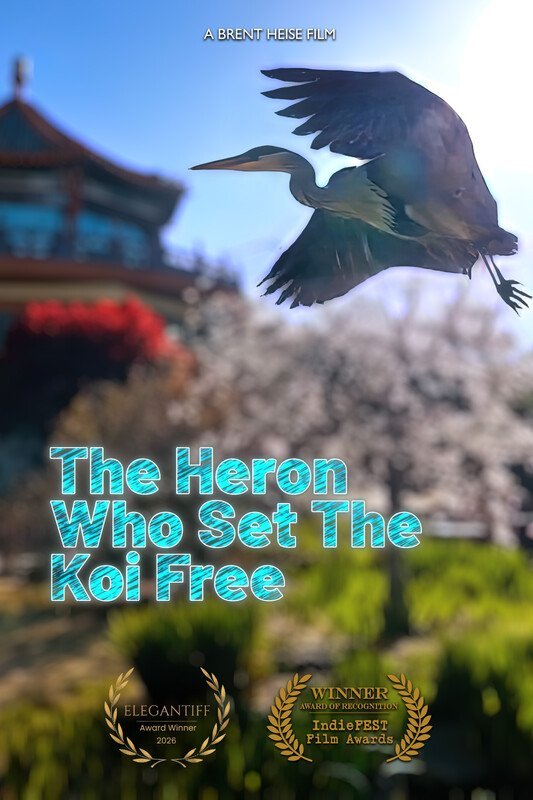
Director’s Statement
An aging heron frees the koi he once hunted. The Heron Who Set The Koi Free emerged from my fascination with the possibility of grace arriving late in life. I wanted to create a film that moves less like conventional narrative cinema and more like memory or meditation — a work shaped by atmosphere, rhythm, and moral awakening rather than plot mechanics. The film centers on a predator who gradually turns away from instinct. The heron begins as a creature formed by survival, repetition, and hunger, yet age opens a space within him where compassion unexpectedly enters. That transformation became the emotional heart of the piece. I was interested in whether mercy can arise not from innocence, but from long familiarity with violence and loss. The narration was written as lyrical verse because poetry offered a timeless and almost fable-like distance from realism. I wanted the language to feel weathered and elemental, as though the story had always existed somewhere beside the marshes and rivers it depicts. The cadence of the poem intentionally echoes older literary traditions while remaining emotionally direct. At its core, the film asks whether a life shaped by taking can still arrive at an act of release. The heron’s final gesture is small in worldly terms, yet spiritually immense to him. In freeing the koi, he briefly steps outside the cycle that defined his existence. That moment became, for me, an image of redemption without sentimentality — fragile, uncertain, but real.
Credits
| Director | Brent Heise The Girl Who Faded Away |
| Writer | Brent Heise The Girl Who Faded Away |
| Producer | Brent Heise The Girl Who Faded Away |
Trailer
The Heron Who Set the Koi Free was submitted to Pageant Film Festival through FilmFreeway in Season 21. Read the Pageant Magazine issue for the season or browse all festival results.