
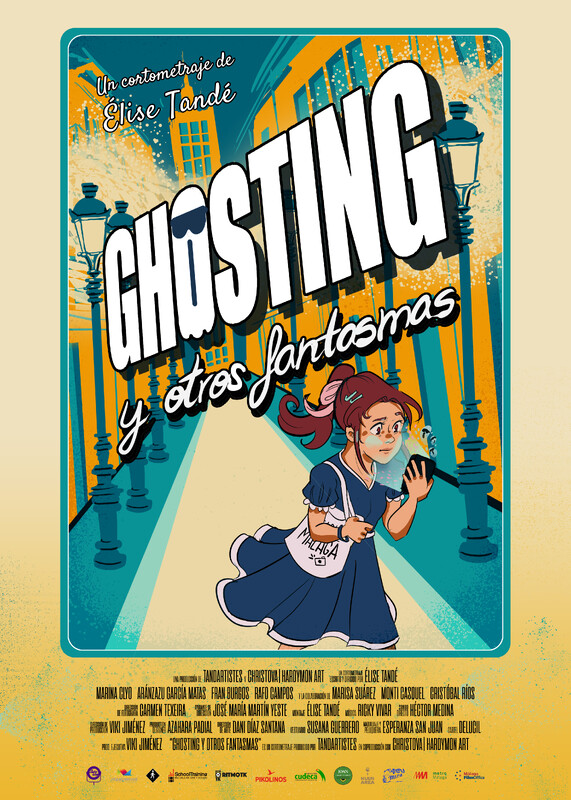
GHOSTING AMONG GHOSTS
Directed by Élise Tandé
Ratings:★★★★☆ (7/10)
There is something almost paradoxical about a film set in Málaga — a city of blinding light, warm stone, and perpetual human noise — choosing to explore the quiet, cold phenomenon of being ignored. But that tension is precisely where Élise Tandé’s Ghosting Among Ghosts finds its voice, and what a distinctive voice it turns out to be.
The film follows Laura, a young woman navigating the emotionally exhausting landscape of modern dating, where people vanish without a word and connections dissolve like smoke. Tandé’s central conceit — that the ghosts of modern ghosting are literal spectral figures drifting through the sun-drenched streets — is a masterstroke of contemporary metaphor. It transforms a quietly devastating emotional experience into something visible, even comic, and in doing so, makes the pain of it all the more legible.
From the very first frame, the film announces itself visually. The cinematography is consistently vibrant, anchoring its surreal premise in the tangible energy of Málaga’s streets and markets. An early scene at the 01:22 mark captures the city’s sheer kinetic life with particular brilliance — it is the kind of filmmaking that reminds you how effectively a camera can make the world feel both real and dreamlike at once. The intimate close-ups on Laura are equally strong, communicating her inner turbulence with economy and grace.
At the heart of the film is a lead performance of commendable authenticity. Laura’s journey from frustration to a hard-won personal resolution is rendered with genuine emotional intelligence, and her dynamic with Ramón — sharp, witty, and intellectually alive — is one of the film’s consistent pleasures. Their exchanges carry the film’s conceptual weight without ever feeling like a lecture.
Equally impressive is the jazz-infused score, which feels organically born from the film’s Mediterranean setting. It amplifies the buoyant spirit of the piece and, in quieter moments, underscores emotional beats with an admirable lightness of touch. It is the kind of music that stays with you after the credits roll.
Where Ghosting Among Ghosts is somewhat less sure-footed is in the balance between its meta-narrative ambitions and Laura’s emotional arc. The film’s self-reflexive moments — where characters acknowledge the act of filmmaking itself — are undeniably clever and lend the work an additional layer of originality. But there are instances where these observations sit slightly outside the story rather than emerging from within it, momentarily loosening the audience’s grip on Laura’s immediate experience. A scene around the 04:00 mark, thoughtful in intention, lingers just long enough to gently disrupt the film’s otherwise brisk momentum. These are minor calibrations rather than structural failures, but they point to a next creative step for Tandé: finding ways to weave conceptual sophistication so seamlessly into the fabric of character that the two become indistinguishable.
The production design, particularly in its handling of the deliberately simple visual effects, deserves a quiet word of praise. The spectral figures are rendered with a knowing, low-fi charm that serves the film’s comedic register perfectly — there is a confidence in that restraint.Ghosting Among Ghosts is, ultimately, a film of real personality. It is original, visually assured, emotionally resonant, and — crucially — fun. Tandé demonstrates a filmmaker’s eye for the image and a writer’s ear for dialogue, and her ability to root a surreal premise in recognisable human feeling is no small achievement. With some tightening of its more discursive impulses, this is exactly the kind of work that lingers in the mind long after the final frame.