
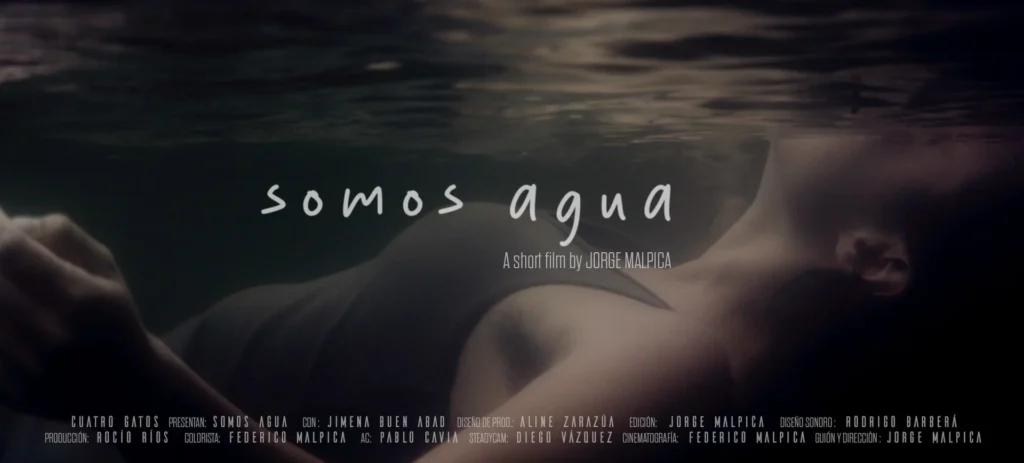
Directed by Jorge Malpica
Ratings: 9.7/10
Grief, the poets tell us, is not a thing you get over. It is a thing you get wet with. You carry it the way the ocean carries salt — invisibly, completely, until everything you touch tastes of it.
Jorge Malpica knows this. And in Somos Agua, his quietly devastating short film that took Best Short Film at the Pageant Film Festival, he has made something rare and almost frightening in its emotional precision: a film that doesn’t describe grief so much as become it.
The Metaphor That Holds Everything
Water doesn’t decide its own shape. Pour it into a glass and it becomes a glass. Pour it into a palm and it becomes something smaller, more fragile, something that will evaporate before you’ve finished looking at it. Loss works the same way. It takes the shape of whoever is carrying it — the size of their silences, the texture of their rituals, the specific weight of an ordinary object that will never be ordinary again.
A tennis ball. An empty food bowl. Small, unremarkable things that have been catastrophically redefined.
This is Malpica’s central insight, and it is delivered not as dialogue, not as voiceover, not as anything so blunt as explanation — but as pure, unmediated image. He trusts you to feel it. More impressively, he trusts his film to make you feel it without being told that you should. That kind of confidence in an audience is increasingly rare. In a filmmaker this early in the arc of what is clearly going to be a significant career, it is extraordinary.
A Director Who Paints With Light and Restraint
There is a school of filmmaking that believes more is more — more score, more close-ups, more cutting, more confirmation that yes, this moment is Important, please feel something now. Malpica did not attend that school.
Somos Agua is built on silence and stillness the way a cathedral is built on stone — not as absence, but as structure. The deliberate restraint here is not timidity. It is discipline of the highest order, the kind that requires a filmmaker to trust that a held frame will do the work that three lesser directors would attempt with a montage and a string section.
The cinematography deserves its own paragraph and probably its own essay. Light moves across water the way memory moves across the mind — diffuse, wavering, capable of sudden startling clarity. Every frame in this film feels considered, not just composed. There is a difference. Composition is craft. Consideration is vision. Malpica has both, and he knows how to let them work together without either one showing off.
The Sequence at the Lake
At four minutes in, the film reaches its centre of gravity, and the film will live in you forever because of what happens next.
A woman wades into a lake. She scatters ashes across the water — the remnants of something beloved, released now into something boundless. And then, slowly, she turns onto her back. Arms out. Face to the sky. And she floats.
No music tells you how to feel. No editor cuts away to protect you. The camera simply stays, and watches, and lets the image do what images almost never get the chance to do in cinema: breathe, expand, mean.
It is thirty-four seconds long and it contains an entire theology of grief. The idea that the body, which has been held so rigid by sorrow, can finally be held by something else. That water — shapeless, formless, everywhere — can become an embrace. That letting go and being held are not opposites. That they might, in fact, be the same gesture.
It is the kind of moment that makes you want to be a filmmaker. It is also the kind of moment that makes you understand you might not have it in you — because moments like this come from somewhere very deep, and they cannot be engineered.
The Performance at the Film’s Heart
She says almost nothing, and she communicates everything.
The lead actress gives a performance of such internal richness that you forget you are watching craft. You are simply watching a person — a person navigating the geography of loss with the kind of quiet, muscular dignity that refuses to perform for your sympathy but earns it completely anyway. Her body knows this grief. Her hands know it. The way she moves through spaces that used to be shared — carefully, like someone trying not to disturb a wound — is more articulate than most scripts.
This is what great direction and great performance look like in collaboration: neither one visible, both of them essential, the seam between them nowhere to be found.
One Door Left Slightly Ajar
If there is a single small wish to offer Somos Agua, it is this: let us in one breath sooner.
The film’s loss — a beloved dog — is established through objects, and those objects are beautifully chosen. But the very first frames carry the film’s full emotional weight on their shoulders, and for a viewer arriving cold, a single additional anchor — a photograph glimpsed in passing, the ghost of a bark that dies in the air before it fully forms — might have made the opening gut-punch land with the force it deserves from the very first second.
This is a very small door left slightly ajar in an otherwise immaculate house. Mention it only because Malpica is clearly the kind of filmmaker who wants to hear it — and because the rest of the film is so accomplished that this level of granularity is all that’s left to discuss.
What Remains After the Credits
The best short films don’t end when the screen goes dark. They continue quietly inside you, rearranging furniture you didn’t know you had.
Somos Agua is that kind of film. It is rooted in the Mexican understanding that the dead don’t leave — they change form, become part of the water and the air and the people who loved them. But you don’t need to know this culturally to feel it cinematically, because Malpica has done what the best filmmakers always do: he has translated something specific into something universal, and in doing so, has made the specific even more precious.
Jorge Malpica has made a film that feels like it needed to exist. That it exists this beautifully — this honestly, this fearlessly — is a genuinely moving thing to encounter.
Water finds its way through everything. So does this film.
Somos Agua (We Are Water) won Best Short Film at the Pageant Film Festival. Directed by Jorge Malpica. Overall jury rating: 9.6/10.